
Understanding Thermal Data and Its Impact on Casting Quality: How to Reduce Scrap Rate in Foundry

Walk into any active foundry, and you will see digital displays flashing thermocouple readings across the shop floor. Yet, in many operations, these numbers are treated merely as generic safety limits rather than actionable metallurgical data. When a shrinkage defect or a cold shut appears, engineers often scramble to adjust mechanical settings, ignoring the story the temperature curves were trying to tell them.
If you are seriously researching how to reduce scrap rate in foundry operations, you must transition from simply "looking" at temperatures to mathematically analyzing thermal gradients. Casting is, at its core, a thermodynamic transfer process. Mastering this transfer is the ultimate key to zero-defect manufacturing.
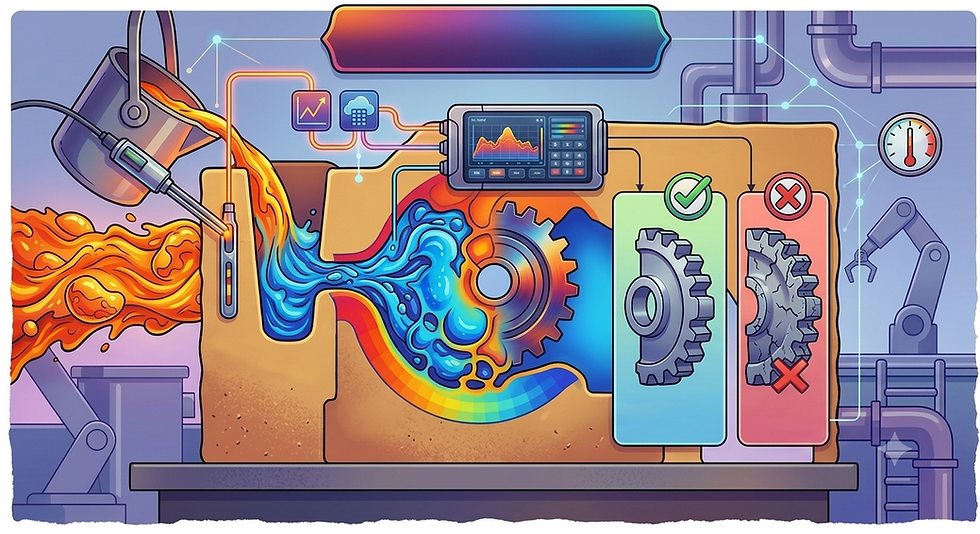
The Mathematics of Solidification: Why Thermal Gradients Matter
The difference between a sound casting and scrap is written in the cooling rate. When molten metal fills a cavity, it must solidify directionally toward the risers (or feeders). If the thermal gradient is compromised, you lose directional solidification, resulting in isolated liquid pools that inevitably turn into macro-shrinkage porosity.
Thermocouple Lag and Real-Time Solidification
Consider an active pouring line. You are pouring an A356 aluminum alloy. The liquidus temperature is roughly 615°C, and the solidus is near 555°C. The gap between these temperatures is your "mushy zone."
If your mold temperature drops below the optimal 250°C to, say, 180°C because of a delayed cycle, the thermal shock at the metal-mold interface alters the local $\Delta T/\Delta t$ (cooling rate). Standard K-type thermocouples embedded in the die often have a thermal lag of 1.5 to 3.0 seconds due to their protective sheaths. By the time the PLC registers the temperature drop, the microstructural damage—specifically, poor secondary dendrite arm spacing (SDAS)—is already done.
The Latent Heat Signature and Eutectic Arrest
Thermal data is most critical during the phase transition. Whether you are dealing with aluminum die casting or ductile iron sand casting, the cooling curve provides an "arrest point" where latent heat of fusion is released.
For instance, in aluminum alloys, a minor shift of just 2°C to 3°C in the eutectic undercooling plateau strongly signals a loss of modification (e.g., strontium fade). If this statistical variation in the melt isn't caught immediately, the eutectic silicon particles remain coarse and acicular, destroying the final elongation properties of the casting.
How to Reduce Scrap Rate in Foundry: Statistical AI Optimization Without Extra Hardware
Foundries sit on gigabytes of raw thermal data, but human operators cannot run statistical process control (SPC) and multivariable regression on cooling curves in their heads every 60 seconds.
This is exactly where Castella redefines process engineering. Castella is a robust AI foundry assistant that requires absolutely zero extra hardware. It ingests the live data from your existing thermocouples, pyrometers, and PLCs.
Instead of waiting for a defect to happen, Castella executes continuous statistical analysis on your thermal curves. If it detects that the latent heat plateau is shifting or the mold thermal gradient is collapsing, the AI calculates the exact countermeasure. In a matter of seconds, it instructs the operator on how to optimize the cooling line flow rates, adjust the pouring temperature, or modify the holding time. This is the most pragmatic, scientifically proven method on how to reduce scrap rate in foundry environments—optimizing your parameters dynamically before the metal freezes.
FAQ: Thermal Data & AI Optimization in Casting
Q: Do we need fiber-optic sensors to use Castella’s thermal analysis?
A: No. Castella is designed to integrate seamlessly with your existing K-type or N-type thermocouples and PLC data logs. It uses advanced statistical algorithms to extract highly accurate predictive models from standard industrial hardware.
Q: Does thermal data optimization only apply to High-Pressure Die Casting (HPDC)?
A: Absolutely not. The thermodynamics of metal solidification are universal. Castella optimizes parameters across HPDC, Low-Pressure Die Casting (LPDC), and gravity sand casting, for various alloys ranging from aluminum to cast iron.
Q: How does optimizing thermal data actually stop shrinkage porosity?
A: By ensuring strict directional solidification. Castella's AI instantly detects when a specific section of the mold is cooling faster than the feeding path, allowing you to adjust local cooling channel debits before isolated liquid pools form.


Comments